Industry
How to Market a Real Estate Listing (Step by Step)
A step-by-step playbook to market a real estate listing fast, from professional photos and portals to a milestone social schedule and a well-run open house.


To market a real estate listing, start with professional photos and a benefit-led description. Then publish to the MLS and the major portals where buyers actually search. From there, run a milestone schedule from just listed through just sold. The goal is to keep the listing visible the whole way to close, as a repeatable system rather than an afternoon lost in Canva.
Most agents already know the tactics. The hard part is running them in order, every time, without burning a day per listing. This playbook gives you that order, from the day you sign the listing agreement to the day you plant the sold sign.
Start With the Assets Buyers Judge First
Before you post anything, get the photos and the words right. Everything else amplifies these two assets. Weak photos cannot be fixed by more posting or a bigger ad budget. Strong assets make every later step easier.
Professional Photos Are the Listing
Buyers shop online before they ever drive by. The NAR Profile of Home Buyers and Sellers reports that the vast majority of buyers use the internet at some point in their search. Most of them start there. Your photos are the first showing for everyone you never meet in person.
Hire a professional. Phone photos signal a phoned-in listing. NAR research on real estate in a digital age shows photos and online listing presence rank among the most useful tools for moving a home. The cost of a shoot is small against the price of a stale listing.
Get the basics in one session: wide interior shots, a clean exterior, and a few detail frames. Shoot on a bright day with the lights on and the clutter gone. If the home is vacant, a few staged frames help buyers picture the space.
Write the Description for the Buyer, Not the Appraiser
A listing description is sales copy, not a spec sheet. Lead with the lifestyle, then back it with the facts. "Morning light fills the kitchen" beats "east-facing windows" for a buyer scrolling at 10 pm.
Name the benefits buyers cannot see in photos. Call out the walk to coffee, the school zone, and the quiet street. A solo agent juggling three listings can reuse a description framework. Even so, the opening hook should be specific to each home.
Keep it tight. Three short paragraphs beat one dense block. End with a clear next step, such as a link or a prompt to message you for a private showing.
Publish Where Buyers Are Actually Searching
Getting the assets right is wasted if nobody sees them. Distribution is where most listings stall. Post once and forget it, and the listing dies on page four of the search results.
The MLS and Portals Are the Floor, Not the Ceiling
The MLS feeds Zillow, Realtor.com, and Redfin, so it is the baseline. Zillow Research and Realtor.com Research both track how constantly buyers search these portals. Get the listing live, accurate, and fully filled out, with every field and every photo in place.
Then go beyond the portals. You do not control how a portal ranks your listing. So build your own visibility on top of it. Treat the MLS as the start line, not the finish line.
Build a Single Source of Truth for the Listing
Create one place that holds everything. That means the photos, the description, the price, the open house times, and the links. A dedicated listing page or a tidy bio link works. Every post then points back to that one page.
This matters most at volume. A high-output agent running many listings at once cannot rebuild assets channel by channel. Build once, export many times, and avoid version drift between Facebook, Instagram, and your flyers.
Plan the Launch Before the Listing Goes Live
The strongest listings arrive at launch with attention already building. A few days of prep turns day one into a crowd instead of a cold start. This is the window most agents waste by scrambling to make graphics the night before.
Tease It as Coming Soon
If your MLS rules allow it, post a coming soon teaser before the listing goes active. A single exterior photo and a short caption builds a waitlist of interested buyers. By launch day, you have an audience instead of an empty room.
The seller down the block who has been thinking about moving sees the teaser first. That early signal often produces a showing request before the listing is even live. Demand on day one tells the whole market this home is worth watching.
Set a Realistic Budget and Timeline
Most listing marketing costs more in time than in dollars. Professional photography is the one expense worth paying every time. The rest, including social posts, a listing page, signs, and open house promotion, can run at little or no cost.
Budget your hours, not just your money. Decide before launch which steps you do yourself and which you template or automate. A solo agent who plans the week wins back the afternoon a manual scramble would have cost.
Run a Milestone Social Schedule, Not Random Posts
Random posting is why listing marketing feels like a chore. A schedule tied to the deal removes the guesswork. Each milestone is a reason to post that buyers and your sphere expect to see. You stop inventing content and start announcing progress.
The Five Posts Every Listing Should Get
Map your posts to the listing lifecycle. Marcus is a solo agent who is also his own marketing team. This is the schedule he can run on autopilot:
- Just Listed post: publish within 24 hours of going active, with your best three photos.
- Open house countdown: a short series in the three days before, plus a flyer the day of.
- Price improvement alert: only if the price changes, sent to interested buyers.
- Under Contract post: signals momentum and builds urgency around your other listings.
- Just Sold post: a neighborhood result that doubles as prospecting for the next listing.
Each post maps to how the deal actually moves. You never stare at a blank screen wondering what to post this week. The listing tells you.
The schedule also keeps your sphere engaged between listings. People who follow your milestone updates learn that you sell homes and move them. That steady visibility is what gets you the call when a neighbor decides to list.
Make Every Post Look Like One Business
Brand consistency is what separates a pro from a hobbyist feed. Use the same fonts, the same colors, and the same logo placement every time. Inman regularly covers how consistent agent branding builds recognition over a full market cycle.
For a high-volume producer like Jennifer, this is non-negotiable. Six listings that look like six different businesses confuse her sphere. A locked brand kit keeps every export on-brand without a designer touching it.
Consistency also compounds. After a dozen listings, your feed reads as one recognizable brand. That recognition is what turns a scroll into a saved post and a saved post into a call.
Drive Local Attention With an Open House
Digital reaches the most buyers, but the open house still converts the serious ones. The NAR buyer and seller data shows open houses remain a common step in the buyer journey. Treat it as a marketing event, not a sit-and-wait afternoon.
Promote the Open House Before the Doors Open
The open house starts marketing days before, not at 1 pm on Saturday. Post the countdown, share a flyer, and message your sphere. A well-promoted open house draws a crowd, and a crowd creates urgency among the buyers in the room.
Use a yard sign and directional signs the morning of. The classic for sale sign still catches drive-by attention. That is free local exposure you should never skip.
Capture and Follow Up With Every Visitor
Every visitor is a lead, whether or not they want this specific home. Collect names and contact details at the door. Then follow up the same day, while the visit is still fresh in their mind.
A visitor who walks through on Saturday and hears from you Saturday night remembers you. One who hears from you next Wednesday does not. Speed of follow-up is the whole game, and it is where most listing marketing quietly leaks leads.
A simple template helps. Thank them for coming, attach the listing page, and ask one question about what they are looking for. That single reply often turns a casual visitor into a buyer consultation, and a buyer consultation into a second client from the same open house.
Turn the Sold Sign Into Your Next Listing
The sale is not the end of the marketing. The closing is your strongest proof and your best prospecting moment. Skip the just sold post and you waste your most credible asset of the entire deal.
The Just Sold Post Is a Prospecting Tool
A just sold post tells the neighborhood you sell homes like theirs. It is social proof that needs no testimonial. Pair the result with a soft offer, such as a free home value estimate for curious neighbors.
This is how one listing becomes the lead for the next. The seller down the street saw your sign. Then they saw your sold post. Then they called you instead of the agent who never followed up.
Post the sale price only if it helps your case in that market. In a rising area, a strong sold price signals you can hit numbers. Either way, the post should point neighbors toward a conversation, not just a result.
A Repeatable System Beats a One-Off Push
The agents who win at listing marketing are not more creative. They are more consistent. They run the same sequence on every listing, so quality never depends on how busy that week happened to be.
Build the playbook once. Save your templates, your description framework, and your milestone schedule. Then every new listing starts at step one of a proven system instead of a blank page. That is the difference between marketing that scales and marketing that drains you.
How Proplo Builds Your Listing Marketing
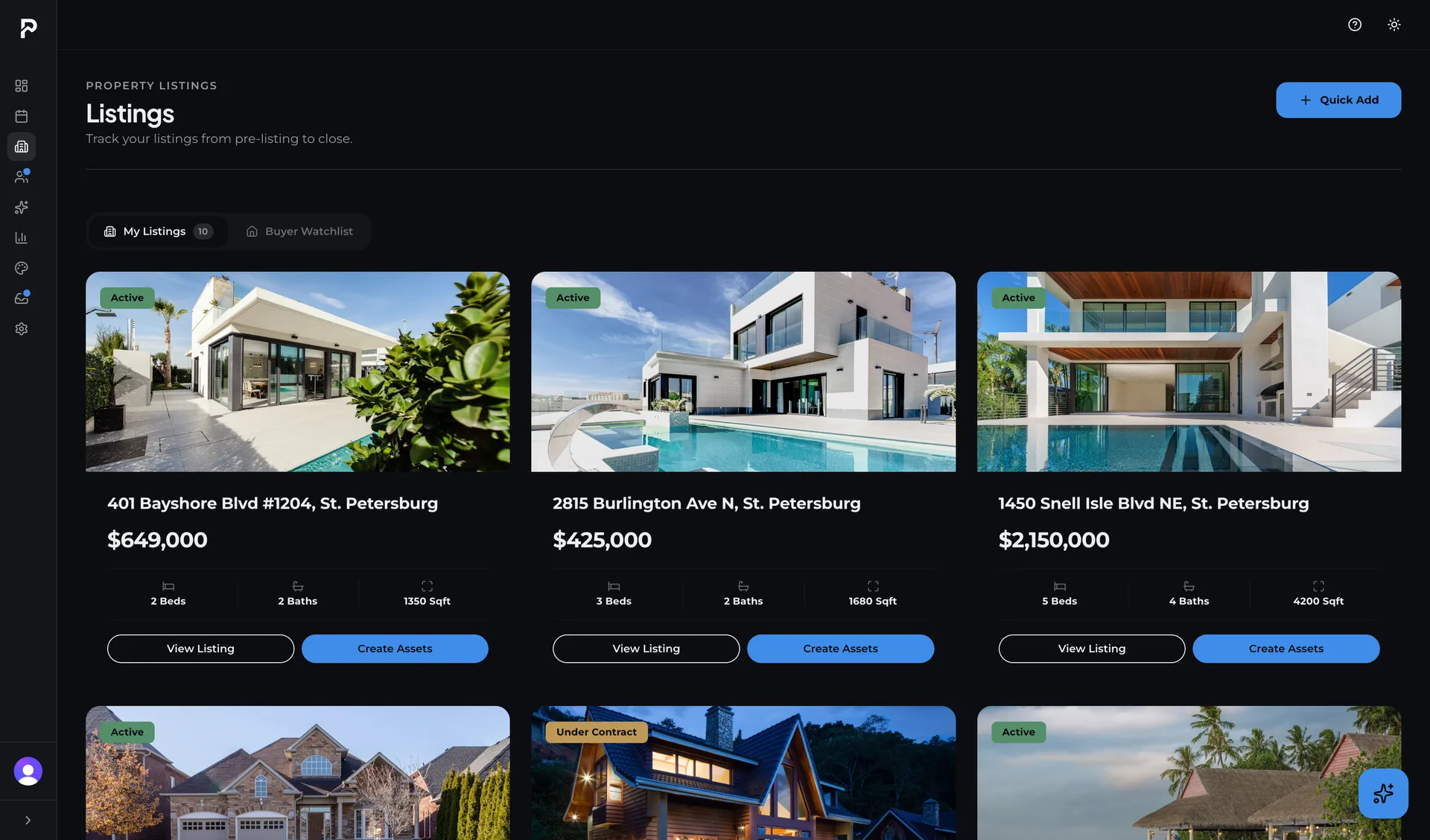
The playbook above is exactly what Proplo automates. The built-in design studio holds professional templates for flyers, just listed cards, open house materials, and social posts. Pick a template, the listing data fills in, and the AI writes the headline, caption, and CTA. You export to PNG, JPG, or PDF from one design, and your Brand Kit keeps the colors, fonts, and logo consistent on every piece.
Proplo also runs the milestone schedule for you. At each stage it pre-builds the post: Just Listed, the open house countdown, Under Contract, and Just Sold. You review and approve in one pass. On Instagram, a keyword comment can trigger an automatic DM to an interested buyer. Pairing it with the AI tools agents actually use gives solo agents a full marketing team without hiring one.
Marketing a listing well is not about doing more. It is about running the right steps in the right order, every time. Build the system once, and your next listing starts marketing itself the day you sign it.

Doni McCarty · Cofounder & Design Lead
Cofounder of Proplo. Twelve years in business management and sales, now leading Proplo's growth and brand. He writes about the systems agents use to win listings and close faster.
LinkedInFrequently asked questions
Marketing a listing ranges from almost free to a few hundred dollars per home. Professional photography is the one expense worth paying for, often 150 to 400 dollars depending on the market. Social posts, a listing page, yard signs, and open house promotion can be done at little cost. The bigger cost is usually time, which is why agents move to templated, repeatable systems.
Post a just listed announcement within 24 hours of going active, using your three strongest photos and a benefit-led caption. Then follow a milestone schedule: an open house countdown, an under contract update, and a just sold post. Keep every post on-brand with the same fonts, colors, and logo so your feed reads as one business, not a scattered collection of one-off graphics.
Start a few days before the listing goes live with a coming soon teaser if your MLS rules allow it. This builds early interest so you arrive at launch with attention already warming. At minimum, have your photos, description, and just listed graphics ready the day before, so you can publish everywhere within the first 24 hours of going active.
Yes, when promoted as an event rather than a sit-and-wait. Open houses remain a common step in the buyer journey, and they convert serious buyers who want to feel the space. The value is amplified by promotion beforehand and same-day follow-up afterward. Even visitors who pass on this home become leads for your next listing.
A just listed post should lead with your best photo, state the location and a standout feature, and include a clear call to action such as a link or a message prompt. Keep the caption short and benefit-led. Add your branding so the post is recognizable, and post it within the first day of the listing going active for maximum reach.