Guides
Best CRM for a Real Estate Team Lead: What Actually Matters
Choosing a CRM for a real estate team is a different job than choosing one for yourself. Here is the framework that matters: lead routing, shared visibility, accountability, and cost per seat.


Photo by Apex Virtual Education on Unsplash
The best CRM for a real estate team lead is the one that makes your team's habits visible without you having to ask. Most "best CRM" lists are written for a solo agent, then have "great for teams too" bolted on the end.
That misses what actually changes when you buy software for four to ten people instead of yourself. You need lead routing that is fair and fast. You need shared visibility into every deal, accountability you can coach from, and a price that makes sense at your actual headcount, not a brokerage's.
Why Choosing a CRM for a Team Is a Different Problem Than Choosing One for Yourself
A solo agent picks a CRM to organize their own contacts and reminders. A team lead picks one that has to work for six other people who did not choose it. Those agents will not read the manual, and they will judge the platform in the first ten minutes.
That is not the same decision as buying software for yourself. Treating it that way is why so many teams end up with a platform nobody actually uses.
You're Not Just a User Anymore, You're an Admin
The moment you add a second agent, you inherit a job you did not sign up for. User permissions, lead assignment rules, and the platform's support queue all become your responsibility now. A team lead running six agents does not have a dedicated ops person to own that. It falls to whoever is already running showings and closing deals: the team lead.
One Agent's Bad Habits Become Everyone's Bad Habits
If one agent on a team ignores follow-up tasks, that is one agent's problem on a solo tool. On a team CRM, it is a leak in the team's pipeline that the team lead is on the hook for.
NAR has tracked that agents already spend a significant share of their week on administrative tasks instead of client-facing work. A CRM that does not surface who is behind on follow-up adds another blind spot on top of that. It multiplies across every agent on the roster.
The 4 Things That Actually Matter When You're the One Buying for the Team
Feature lists are long and mostly noise. Four criteria decide whether a team CRM actually works for a team lead. They rarely show up as headline bullets on a vendor's pricing page.
Lead Routing and Assignment (Does It Distribute Leads Fairly and Fast?)
A lead that sits unassigned for twenty minutes is a lead that is probably calling the next agent on the list. Good team CRMs route new leads automatically, based on rules the team lead sets: round robin, load balance, or specialty. If a lead goes uncontacted for too long, the system needs to escalate, not just log it quietly.
Consider a team where a new buyer lead lands at 6 pm on a Friday. If assignment depends on the team lead noticing a notification, the lead waits until Monday. If assignment is automatic, and the system flags a missed 24-hour window, the team lead can reassign it before the lead goes cold.
Shared Visibility (Can You See the Whole Pipeline Without Asking?)
"What's happening with the Garcia file?" should never require a text message to the agent handling it. A team lead needs one board that shows every deal, every stage, across every agent. No switching accounts, no asking someone to screen-share.
Realtor.com Research has tracked how quickly buyer inquiries go cold without a response, a risk that compounds across a full agent roster. This is the exact gap team leads describe most often: "I have no idea what my agents are actually doing."
A platform that only shows each agent their own pipeline forces the team lead back into asking around. That is slower than the deal itself sometimes moves.
Accountability Without Micromanaging (Can You Coach from Data, Not Guesswork?)
Accountability is not standing over an agent's shoulder. It is having enough data, per agent, to run a specific coaching conversation instead of a vague one.
- Which lead sources actually convert for this agent.
- How many days a lead typically sits before first contact.
- Where deals stall.
Inman has covered how proptech platforms are increasingly expected to give team leads rolled-up reporting, not just individual agent dashboards. Without it, coaching conversations default to "try harder." That does not change behavior. It also does not build trust with the agent on the other side of it.
Cost Per Seat at Your Actual Team Size (Not the Brokerage-Scale Sticker Price)
A platform priced and built for a 200-agent brokerage does not become cheap or simple because you only have six agents. You still pay for the complexity, even if you only use a fraction of it. HousingWire has covered how proptech vendors increasingly price and package for brokerage scale first, with smaller teams absorbing that complexity as a side effect.
The right comparison is not the sticker price. It is what the platform costs per agent, at your size, for what your team will actually use.
How the Main Options Stack Up for a Team Lead
None of the major platforms are built badly. They are built for different buyers, and matching the platform to your actual size matters more than any single feature comparison.
BoldTrail / kvCORE: Built for Brokerage Scale, Felt by a 6-Agent Team
BoldTrail is the current name for what many agents still call kvCORE. It bundles an IDX website, CRM, lead capture, and back-office tools into one system. BoldTrail does not publish team pricing, and trade coverage generally places small-team pricing at roughly $499 to $950 or more per month. Many agents get access subsidized through a brokerage instead.
- Strengths: Behavioral smart campaigns, built-in lead-ad management, a full team and office lead-routing hierarchy, and integrated transaction coordination.
- The catch for a small team: Third-party review platforms consistently describe a steep learning curve. Reviewers also note that many small teams end up using only a fraction of the platform, with nobody on staff to build out the rest.
- Best fit: Brokerages and larger teams with dedicated administrative support to configure and maintain the system.
We covered this pattern in more depth in the case for a simpler alternative built for small teams. That piece walks through what onboarding a new agent looks like on a platform sized for two hundred people.
Follow Up Boss: Strong Routing, but You're Still Building the Rest Yourself
Follow Up Boss is widely recommended in agent communities for clean lead routing, call logging, and team accountability features like action plans and leaderboards. Inman has covered the platform's standing among agent-community favorites since Zillow's 2023 acquisition of the company.
Pricing is tiered and public. Grow runs $69 per user per month. Pro is a flat $499 per month for up to 10 users, and Platform is $1,000 per month flat for up to 30 users. A dialer add-on costs $39 per user per month on the Grow tier.
- Strengths: Real-time lead routing, 250 or more native lead-source integrations, and genuinely strong team accountability tooling for its category.
- The catch for a team lead: Follow Up Boss is a dedicated CRM hub, not an all-in-one platform. It pairs with a separate website provider for IDX, and it does not build marketing materials or run outbound calls on its own.
- Best fit: Teams of two to fifteen agents who already have a website and marketing workflow, and want a focused CRM layered on top.
Lofty (formerly Chime): Feature-Complete AI, Priced for Teams That Are Ready to Configure It
Lofty rebranded from Chime in 2023 and markets itself as an AI-first operating system. It has the most feature-complete AI layer of the incumbents covered here: a text-based copilot for lead-nurturing conversations, automated ad targeting, and IDX-integrated websites. Pricing is not publicly listed, but the Teams tier is generally reported in the roughly $700 to $1,200 per month range.
- Strengths: Broad AI-driven automation across text follow-up, ad spend, and lead generation, plus 30 or more built-in lead-gen methods.
- The catch for a team lead: The AI layer is text and chat only. There is no native voice-calling AI, and reviewers describe a real learning curve to configure the copilot correctly. There is also no built-in marketing design studio, so teams still lean on Canva or another tool for that.
- Best fit: Teams of five to twenty-five agents with the time and budget to configure a deep automation stack. Not the right fit if AI voice calling specifically is the priority.
Where Proplo Fits for a Team Lead
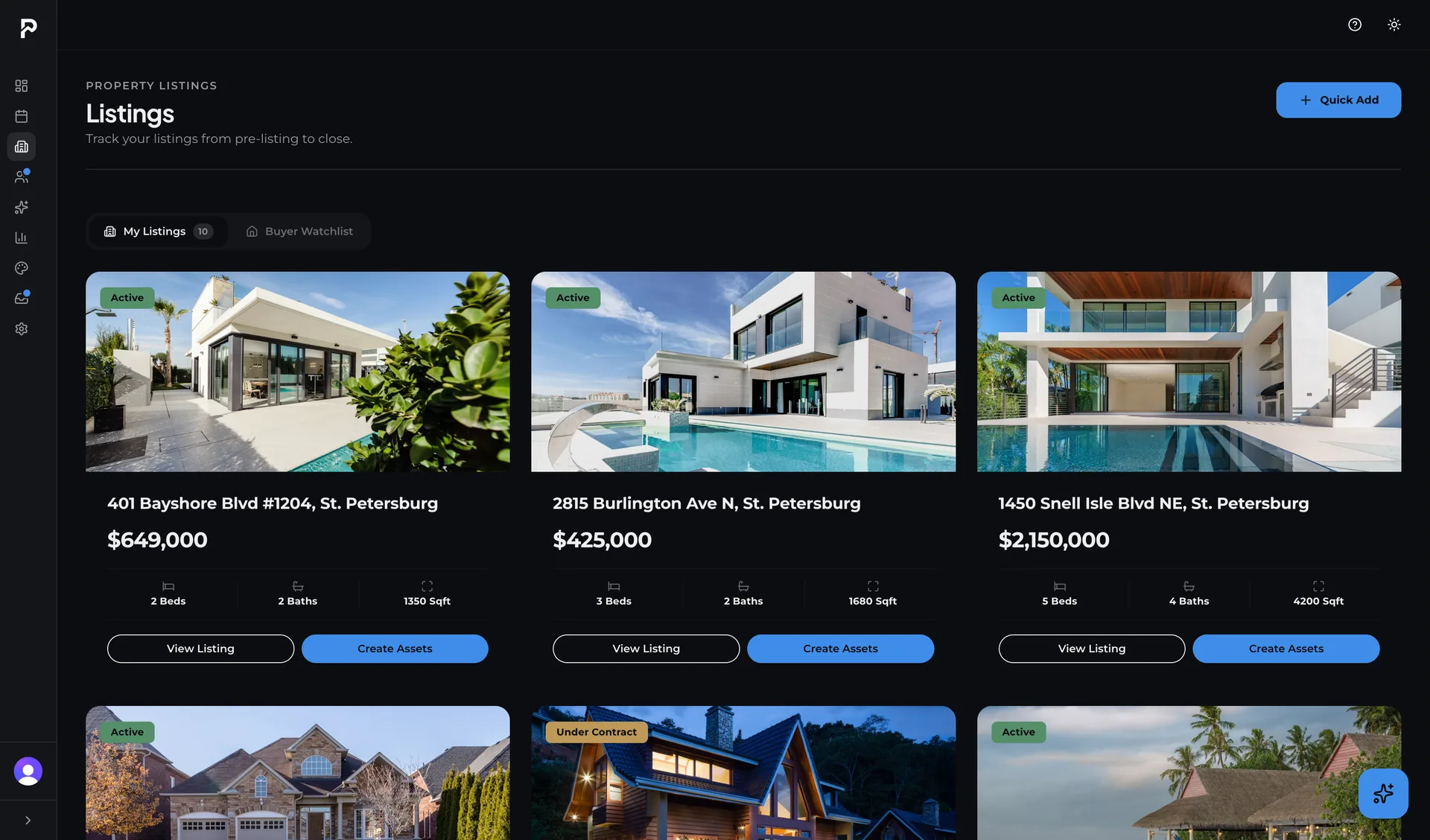
Proplo runs lead assignment for a team on a round-robin basis. A new lead goes to the next agent up the moment it comes in, so it does not sit silently until someone happens to check.
Every agent's pipeline is scoped to their own leads. The team lead's admin view shows the full roster, activity, and status across the team in one place. Preferred vendors, like a lender or title company, are set up once at the team level. Every agent has access from day one instead of building their own list.
A Simple Way to Run the Evaluation with Your Team
You do not need a formal RFP process to make this decision well. You need to ask the right questions on the demo call, then watch what happens once real agents touch the system.
Questions to Ask on Every Demo Call
- Show me exactly what happens when a new lead comes in with nobody assigned yet.
- What does the team lead see that an individual agent does not?
- If an agent does not contact a lead within a day, what happens next, and who finds out?
- What is the actual monthly cost at my agent count, not the brokerage tier?
- How long does onboarding a new agent take, from invite to a working pipeline?
Each question should get a specific, demonstrable answer. If the answer is a general feature list instead of a walkthrough, that is worth noting.
The One Test That Tells You More Than Any Feature List
Run a two-week shadow trial with two or three agents before committing the whole team. Route real leads through it, or a close copy of your real lead flow. Watch whether the team lead can answer "what's happening with this deal" without asking anyone.
A demo shows you what the platform can do. A shadow trial shows you what your team will actually do with it, which is the number that determines whether the switch was worth making.
How Proplo Helps
Everything covered above maps directly to how Proplo's team features work.
The org system is live. A team lead invites agents, and each one is provisioned with their own scoped pipeline. The team lead gets a roster view of every agent's status without asking.
Round-robin assignment, plus a shared vendor directory, means a team does not rebuild routing and vendor lists from scratch. Day one already has both in place.
Explore what a team-focused platform looks like for a team your size, or bring your actual routing and reporting questions to a live walkthrough.
Conclusion
The best CRM for a real estate team lead is not the one with the longest feature list. It is the one that makes lead routing fair, gives you a shared view of the whole pipeline, and lets you coach from real data. It should also cost a fair amount at your actual team size.
Use the four-criteria framework above on every demo you take. Run the two-week shadow trial before you sign anything, and let your agents' actual behavior make the final call, not a sales deck.

Clayton Walker · Founder & Product Lead
Founder of Proplo. Ten years in marketing and motion design for the NFL, MLB, MLS, and NBA. He designs Proplo and leads its product direction. Real estate is the family business.
LinkedInFrequently asked questions
A solo-agent CRM organizes one person's contacts and reminders. A team CRM adds lead routing across multiple agents, a shared pipeline view for the team lead, and accountability reporting per agent. Without those three layers, a team lead is stuck asking each agent for status individually, which defeats the purpose of a shared platform.
It varies widely by platform and team size. Follow Up Boss runs from about $69 per user per month on its entry tier to a flat $499 per month for up to 10 users on its Pro plan. BoldTrail and kvCORE typically run $499 to $950 or more per month for a small team, though brokerage subsidies can lower an individual agent's cost significantly.
Look for automatic assignment rules, such as round robin or load balancing, plus an escalation path when an assigned agent does not make contact within a set window. Routing that requires the team lead to manually notice and reassign a stalled lead defeats the purpose of automation and slows down response time.
Yes, with the right reporting layer. A team lead should be able to see per-agent activity, lead source performance, and pipeline stage without asking for a status update. That visibility supports coaching conversations grounded in data instead of guesswork, which reads as support rather than surveillance to most agents.
It depends on team size and available administrative support. BoldTrail and kvCORE bundle a wide feature set built for brokerage scale, which can feel overbuilt for a four to ten agent team without a dedicated admin to configure and maintain it. Teams with brokerage-subsidized access often find the cost tradeoff more favorable than teams paying full price.
Plan for at least a few weeks: data migration, agent training, and a settling-in period where old habits compete with the new system. Running a two-week shadow trial with two or three agents before a full team migration surfaces most adoption problems early, when they are still cheap to fix.