Guides
How to Keep Real Estate Agents from Leaving Your Brokerage
Independent brokerages lose agents to national brands every year, and technology is consistently in the top reasons they cite. Here is a practical framework for diagnosing why agents leave and fixing the structural gaps before the next resignation letter arrives.


Keeping real estate agents at your brokerage starts with three things: productivity, visibility, and tools that match the competition. An independent brokerage rarely loses agents because the split is wrong. It loses them because friction accumulates until a better offer tips the scale. Fix the friction first.
Why Real Estate Agents Leave (and What They Tell You vs. What They Mean)
Exit interviews in real estate tend to sound the same. The split came up. The brand wasn't the right fit. The actual reasons usually started building months earlier.
The Split Is Often the Cover Story
Most agents who leave for a higher commission split were already mentally disengaged before the offer arrived. The financial argument lands only after the agent has decided to look. Root causes are quieter: isolation from the team, no coaching feedback, and tools that create manual work instead of removing it.
Here is a common pattern. An agent with 12 transactions per year manually rebuilds marketing flyers for each listing. They re-enter client info across three disconnected tools. They get zero guidance on which leads to prioritize.
The split is reasonable. The friction is not. When eXP or Compass arrives with a unified platform and a comparable split, the decision takes about a week.
Technology Is Cited More Often Than Brokers Realize
Inman coverage of agent movement consistently surfaces technology quality as a top reason agents switch brokerages. This is especially true among agents in their third through seventh year. These agents have defined workflows and know what good tools feel like. When your platform does not deliver, they start looking.
Mid-career agents with established pipelines feel friction most acutely. They have enough volume to see exactly where the tools are slowing them down.
The Retention Risk Signals Brokers Miss
The biggest retention mistake is treating agent departures as unpredictable. Most of the time, the signals were there. The broker just did not have the visibility to see them.
Activity Decline Is the Earliest Warning
An agent who stops logging calls, lets pipeline tasks pile up, and disengages from team meetings is not lazy. They are checking out. Whether your brokerage catches this early depends on one thing: visibility into each agent's activity.
According to NAR membership research, roughly 16% of licensed agents change brokerages in a given year. That number has held steady for years. The brokerages losing fewer than 16% are not lucky. They are watching.
The 60-to-90-Day Escalation Window
Agents who are about to leave typically escalate friction complaints in the 60 to 90 days before they give notice. They ask about CRM workarounds. They submit help tickets on tools they were tolerating before. They stop uploading deal documents.
A broker with visibility across every agent's pipeline can intervene during this window. A broker without it gets a resignation letter.
Five Levers That Actually Reduce Agent Turnover
These five levers work together. Pulling one in isolation helps. Pulling all five is what separates high-retention brokerages from those replacing half their roster every two years.
Lever 1: Give Every Agent the Same Tools as the Biggest Teams
The single strongest recruiting pitch from eXP and Compass is a free, integrated platform that makes agents productive from day one. An independent brokerage does not need to build that platform. It needs to provide one.
Agents who feel the brokerage is investing in their success are more likely to stay. They need a pipeline that tracks every deal from first contact to close. They need automated follow-up so no lead goes cold during a showing.
They need a marketing tool that produces professional listing materials fast. These are not nice-to-haves. They are the baseline expectation at well-run teams, and closing that gap for independent brokerages is exactly what Proplo is built to do.
HousingWire has covered the technology gap between independent brokerages and national brands repeatedly. Independent brokerages that invest in integrated platforms retain agents at higher rates than those running on disconnected tools.
Lever 2: Structured Onboarding Reduces First-Year Attrition
The highest attrition in real estate happens in the first 12 to 18 months. New agents enter expecting early wins and find the ramp slower than anticipated. Many exit quietly rather than ask for help.
Brokerages with structured onboarding report significantly better first-year retention. That means a scripted first-week workflow, a mentor agent assigned from day one, and a platform that tells new agents what to do next. NAR data confirms that a large share of new agents leave the industry within their first five years. Brokerages that change that number do so through systematic support.
A first-year agent who knows what to do each morning does not feel lost. An agent who feels lost becomes a statistic.
Lever 3: Build a Feedback Loop That Does Not Require a Meeting
Monthly reviews are too slow and too formal. Agents who feel unseen between check-ins disengage quietly. The answer is not more meetings. It is visibility.
A broker reviewing pipeline activity weekly can give specific feedback: "You have five buyer leads at Contacted stage that haven't moved in two weeks. What is the obstacle?" That is a coaching conversation, not a performance review. It is also the kind of attention that makes agents feel the brokerage is on their side.
Lever 4: Brand Consistency as a Retention Tool
Agents who are proud of how their marketing looks are harder to recruit away. Listing flyers, social posts, and "Just Sold" cards that look professional every time build association with your brokerage. Agents credit the platform, and by extension, the broker who chose it.
Inconsistent branding does the opposite. An agent spending 40 minutes on a mediocre Canva flyer starts to feel the brokerage is not invested in their success. When a national brand offers on-brand marketing built into the platform, the agent has one fewer reason to stay.
Lever 5: Be Explicit About the Career Path
Agents with no visibility into what comes next at your brokerage create their own next step. That next step is often a different brokerage.
A broker who annually maps each agent's trajectory using real production data gives agents a concrete reason to stay. What does it take to reach a senior designation? What would building a team here look like?
Is there an equity path for agents who hit certain benchmarks? The answers do not need to be perfect. They need to be specific.
How Proplo Helps You Keep Agents
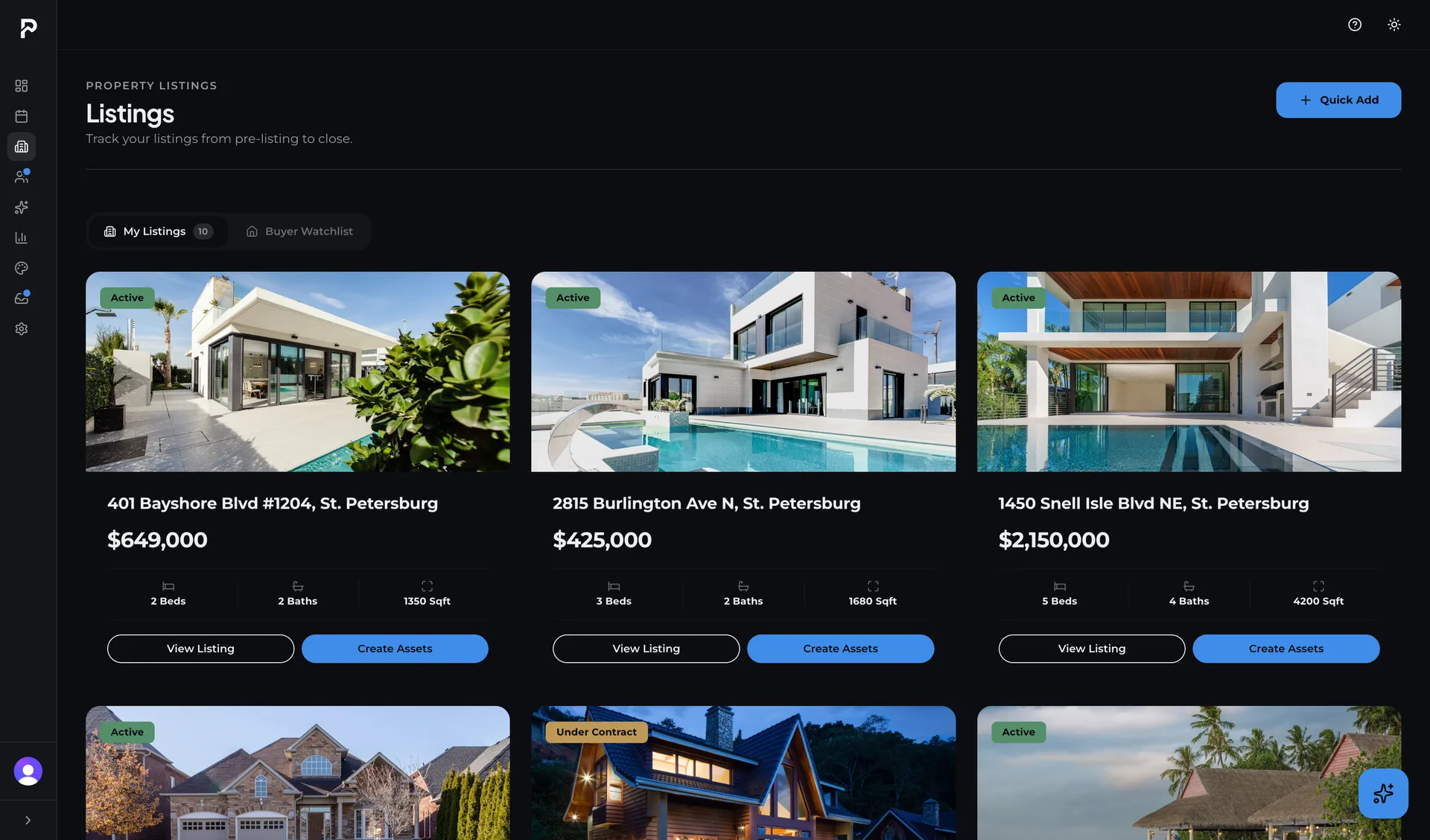
The retention gap for independent brokerages is largely a platform problem, and that is the part Proplo closes. Proplo's org system lets you invite agents, assign them to teams, and share a vendor directory across the brokerage, with each agent's pipeline and leads privately scoped. Every agent gets the same lead calling, follow-up automation, and listing marketing tools that used to require five separate subscriptions, so the tooling stops being a reason to leave.
The broker admin dashboard is where retention turns proactive. It shows every agent's pipeline activity in one view, calls made, follow-up sequences running, deals in motion, so a broker who sees activity dropping can have a specific, data-informed conversation before the resignation letter arrives.
Retention Is a System, Not a Conversation
The brokerages that keep their agents longest are not always the ones that pay the best. They are the ones where agents feel equipped and invested in. That comes from structured onboarding, coaching rooted in real data, and marketing tools that make agents look professional.
Start with the Technology Audit
If you do not know how many separate tools your agents manage today, start there. Count them. Then ask: which could be replaced by a single platform? For most independent brokerages, the answer is four or five.
Agents leave because friction adds up. Removing that friction is the most durable retention strategy available to an independent brokerage that cannot match a national brand's name recognition.

Doni McCarty · Cofounder & Design Lead
Cofounder of Proplo. Twelve years in business management and sales, now leading Proplo's growth and brand. He writes about the systems agents use to win listings and close faster.
LinkedInFrequently asked questions
According to NAR membership data, roughly 16% of licensed agents change brokerages in a given year. That rate has remained consistent between 16% and 18% since 2020. The agents most likely to switch are in their third through seventh year, when they have enough experience to evaluate platforms critically and enough production to attract recruiting offers from competing brands.
Commission split is the most commonly stated reason, but it is often a secondary factor. Agents who leave for a better split typically cite technology friction, lack of coaching or feedback, and no clear career path as underlying motivations. Technology quality has risen into the top reasons agents switch, particularly among mid-career agents who have established workflows and defined expectations for what good tools look like.
Independent brokerages compete by winning on culture, training, and tools, not on brand or split alone. The most effective counter to national recruiting pitches is providing agents with an integrated platform that handles lead follow-up, pipeline management, and listing marketing automatically. Agents who feel productive and supported are significantly harder to recruit away, regardless of brand size. Explore the [brokerage solution built around retention](/for-brokerages) for a platform designed for independent owners.
Agents expect a CRM that tracks every deal from lead to close, automated follow-up that runs without manual input, professional marketing tools for listings and social posts, and a pipeline view that tells them who to contact today. When the brokerage platform does not provide these, agents build their own stack or move to a brokerage that provides it for them.
The earliest signal is a decline in logged activity: fewer calls recorded, pipeline tasks piling up, reduced engagement in team channels. Agents typically escalate friction complaints and reduce platform usage in the 60 to 90 days before giving notice. A broker with brokerage-wide activity visibility can spot these patterns early and intervene with a coaching conversation before the decision is made.