AI & Automation
AI Real Estate Tools 2026: A Category-by-Category Guide
AI real estate tools in 2026 sort into five real categories, not a list of logos. Here is what each one solves, what to check before buying, and where one platform can cover more than one at once.


Photo by MART PRODUCTION on Pexels
AI real estate tools in 2026 fall into five real categories: voice and calling, pipeline copilots, predictive scoring, marketing and design, and transaction automation. Most "AI tools for real estate" lists skip the categories and jump straight to a stack of vendor names. That tells you nothing about what each tool actually does.
This guide breaks down what each category solves and what to check before buying into it. It also covers where a single platform can cover more than one category at once.
The Five Categories of AI Real Estate Tools in 2026
Every product marketed as AI real estate software in 2026 does one of five distinct jobs. A tool that calls leads, a tool that answers pipeline questions, and a tool that scores intent are not competitors. They solve different parts of the day, and most agents own pieces of more than one category without realizing it.
The Category Map
- AI voice and calling: places outbound calls to qualify a new lead and reports back what it learned.
- AI copilot and pipeline Q&A: answers plain-English questions about your pipeline and drafts messages on request.
- Predictive and propensity scoring: estimates how close a lead is to buying or selling, based on behavior and market signals.
- Marketing and design AI: builds listing flyers, social posts, and captions from your listing data.
- Transaction and deal automation: handles vendor coordination, deadline tracking, and document checklists after a deal goes under contract.
Where the Categories Get Blurred Together
Vendors rarely market a tool by category. They market it by feature name, which makes two very different tools sound alike. A "smart assistant" could be a copilot answering questions, or a scoring engine ranking leads behind the scenes. The product page rarely says which.
Inman has tracked this exact pattern in its proptech coverage. Three products marketed as an "AI CRM" can be three entirely different tools underneath the label.
A solo agent comparing three vendor demos in one afternoon can walk away thinking she compared three CRMs. In reality she compared a copilot, a scoring tool, and a marketing generator bolted onto the same login screen. Knowing the category first prevents that confusion.
AI Voice and Calling Tools
AI voice and calling tools place an outbound call to a new lead and ask qualifying questions. They hand the agent a transcript and summary before any human follow-up happens.
The category exists for a timing reason. NAR's Profile of Home Buyers and Sellers research shows most buyers work with the first agent who engages them in a meaningful way. The agent who reaches a lead first usually keeps the relationship.
Proplo's AI voice agent, for example, places a qualifying call within minutes of a new lead coming in. It records the call and pulls budget, timeline, and objections into a plain-English summary the agent reads before calling back.
What to Look for in an AI Calling Tool
Not every calling tool is built the same way. Before buying into this category, check three things.
- Speed: how fast the first call actually goes out, not just what the marketing page claims.
- Usability: whether the transcript and summary are usable on their own, without relistening to the whole call.
- Escalation: whether the tool hands off to a human when the conversation calls for it.
A tool that calls fast but hands the agent a raw, unstructured transcript has only solved half the problem.
The Consent Question Most Agents Skip
AI-generated calls to a lead's cell phone fall under TCPA rules the FCC enforces. Those rules require prior express written consent for automated or AI-driven outreach in most cases. Skipping this question is not a small risk. TCPA violations carry per-call penalties.
AI Copilot and Pipeline Q&A Tools
An AI copilot answers plain-English questions against an agent's real pipeline data and drafts communication on request. It is a different job than a voice agent. A copilot works from inside the CRM, not on the phone with a lead.
Consider an agent opening the app before a Monday morning call block. Instead of clicking through forty contact records, she asks the copilot which leads have gone quiet for more than a week. The answer takes seconds instead of ten minutes of scrolling.
What Separates a Real Copilot From a Chatbot Widget
Plenty of platforms bolt a generic chatbot onto their CRM and call it AI. The difference between that and a real copilot comes down to context.
- A chatbot widget: answers generic questions about how to use the software, with no visibility into the agent's actual leads.
- A real copilot: has direct access to pipeline data, client history, and past conversations, and answers using that specific business.
Proplo's AI copilot has full context on the agent's pipeline, clients, and deal history. It remembers facts about clients across sessions instead of starting fresh every time. An agent can ask who her hottest buyers are right now, or have it draft a follow-up using the actual conversation history with that client.
Predictive and Propensity Scoring Tools
Predictive and propensity scoring tools estimate how close a lead is to buying or selling. They use behavioral data like page views, saved searches, and life-event signals. Zillow Research and Redfin both study the market-level version of these signals, which is where most vendors source the underlying data.
The category has a reputation problem. Many tools reduce all of that signal into a single number, like a lead scored 82. A number does not tell an agent what to do next.
Scores vs. Bands: What Actually Changes Your Next Call
An agent staring at a list of 60 leads ranked 1 to 100 still has to decide, alone, what a 78 means today. A tool that instead sorts leads into plain categories, like Nurture or Ready to Act, skips that translation step entirely.
Proplo's propensity read places every lead into one of four bands: Not Yet Reached, Nurture, Actively Looking, Ready to Act. Each band carries a confidence level and the specific signals behind the placement, and no raw number is ever shown.
Marketing and Design AI Tools
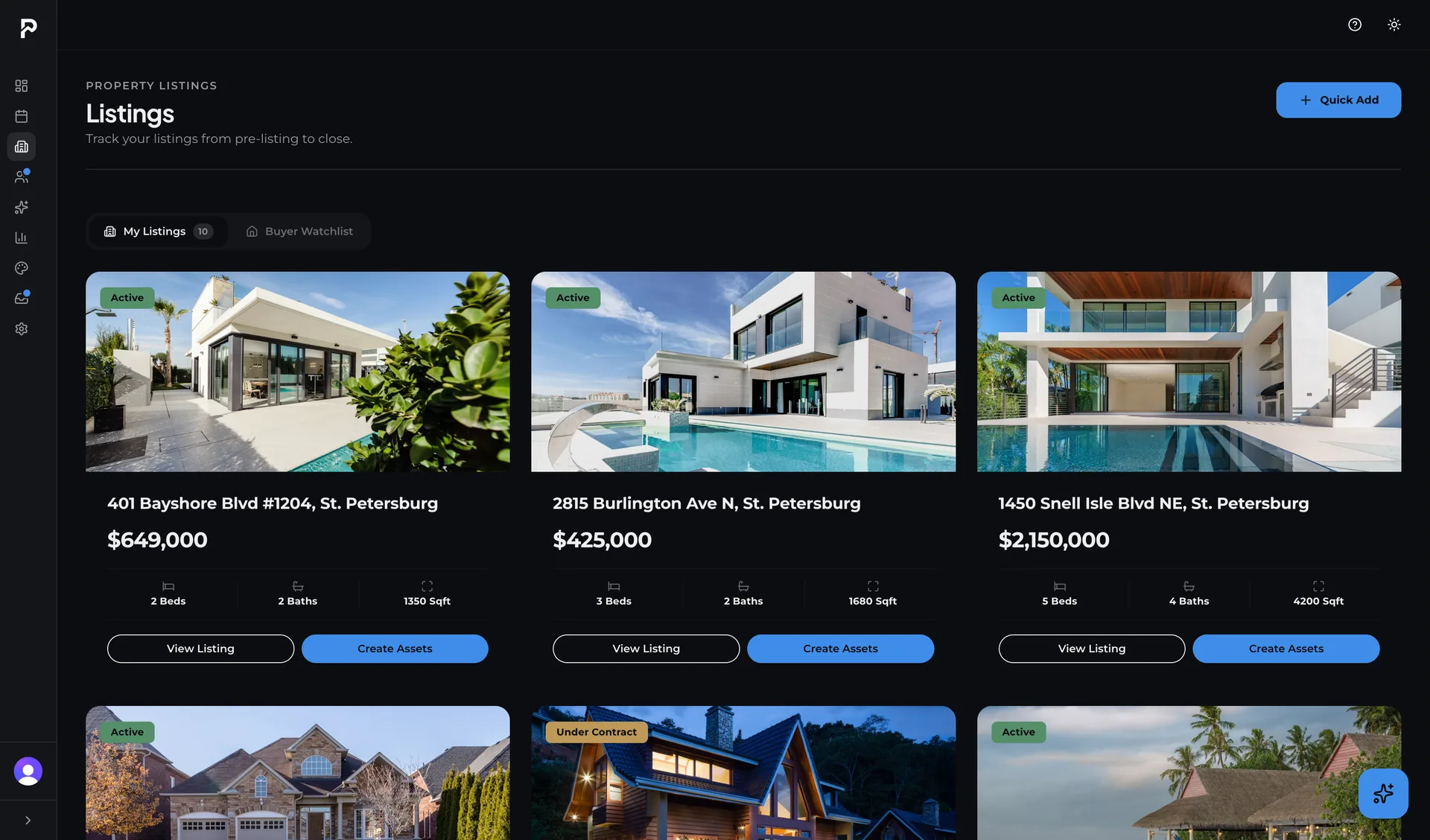
Marketing and design AI tools generate listing flyers, social posts, and captions from an agent's listing data. They replace the hours agents used to spend rebuilding the same template in a general design app.
Picture an agent with three new listings on a Friday afternoon and no time to build three separate flyer sets from scratch. A tool that auto-fills price, address, and photos from the listing record turns that into a quick task instead of an evening one.
What to Look for Beyond "AI-Generated" as a Checkbox
Most vendors in this category advertise AI-written captions as the headline feature. That is the easy part. The harder question is whether the output stays on-brand across every agent using the tool. Otherwise every listing ends up looking like it came from a different business.
- Brand consistency: does the tool lock in colors, fonts, and a logo so output stays consistent across agents.
- Format coverage: does one design export cleanly to social, print, and email without rebuilding it three separate times.
- Approval setting: can the agent choose whether the caption and design wait for approval or publish on their own.
Transaction and Deal Automation Tools
Transaction and deal automation tools handle the coordination work that starts the moment a deal goes under contract. That includes vendor intro emails, deadline tracking for inspection and appraisal, and document checklists tied to each stage of the deal.
An agent juggling five deals under contract at once cannot hold every inspection deadline and vendor email in her head. A missed deadline on one deal can stall the whole transaction, and catching it late costs far more than a reminder would have.
Automation vs. Approve-First: Why the Setting Matters
Some tools in this category send vendor and client emails automatically, with no review step. That works until a deal has an unusual wrinkle the automation did not anticipate, and an email goes out that does not fit the situation.
An approve-first design avoids that failure mode without slowing the agent down. The tool drafts the vendor and client emails, and the agent approves each one in one click before it sends. The better tools let you choose, automation by automation, whether a message waits for approval or runs on its own.
Choosing Between Point Tools and One Platform
A single-category point tool can go deeper than a combined platform in that one category alone. A dedicated design tool built only for real estate marketing may ship more templates than a platform that also handles calling, scoring, and transactions.
When a Point Tool Still Makes Sense
A specialist tool earns its place when one category is clearly the bottleneck and the agent is not ready to change five workflows at once. An agent whose biggest problem is slow-looking flyers does not need to replace her whole CRM to fix that.
When One Platform Wins
The tradeoff shows up in the seams once an agent owns three or more point tools. Every extra tool means re-entering the same lead's name, phone number, and address in a second login. HousingWire has covered the same frustration from the broker side. Teams running five separate tools lose a single view of which lead sits in which stage across the whole group.
A platform built for solo agents removes that re-entry problem once volume grows past what a single point tool can carry.
How Proplo Covers These Categories
Proplo covers all five categories in one system instead of five separate logins. The AI voice agent handles calling, the AI copilot answers pipeline questions, and propensity bands replace numeric scores. The design studio builds on-brand listing marketing, and the Deal Document Center manages transaction paperwork.
Agents can see the full feature set or start with the piece that solves their most immediate problem first. The categories in this guide are not a shopping list to complete all at once. They are a map for evaluating whatever a vendor puts in front of you next.

Clayton Walker · Founder & Product Lead
Founder of Proplo. Ten years in marketing and motion design for the NFL, MLB, MLS, and NBA. He designs Proplo and leads its product direction. Real estate is the family business.
LinkedInFrequently asked questions
There are five: AI voice and calling tools that qualify new leads, AI copilots that answer questions about your pipeline, predictive scoring tools that estimate lead readiness, marketing and design AI that builds listing content, and transaction automation that handles paperwork and vendor coordination after contract.
It can be, but consent rules apply. TCPA rules the FCC enforces require prior express written consent for automated or AI-driven calls to a lead's cell phone in most cases. Before using an AI calling tool, confirm exactly how it captures and documents that consent for each lead source.
A generic chatbot widget answers questions about how to use the software, with no visibility into an agent's actual leads. A real AI copilot has direct access to pipeline data, client history, and past conversations, so it answers questions and drafts messages using that specific agent's business.
Many still show a raw number, like a lead scored 82, which leaves the agent to decide what that number means before acting. Some tools instead sort leads into plain categories, such as Nurture or Ready to Act, paired with the specific signals behind the placement, which is easier to act on.
It depends on volume. A single point tool can go deeper in one category and makes sense when one problem is the clear bottleneck. Once an agent owns three or more separate tools, re-entering the same lead's information across logins becomes its own time cost, which is where a combined platform starts to win.
It replaces the routine work: auto-filling listing data into a template, writing a caption, and exporting to multiple formats. It does not replace judgment on brand consistency or unusual creative requests. The strongest tools in this category let the agent choose whether a post waits for approval or publishes on its own.